The Colombo V12 Ferrari Engine
The 356 GT was instrumental in the development of the Colombo V12Ferrari Daytona V12 Engine
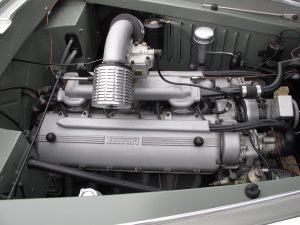
Early versions of the Colombo V12 had a single carburettor
Enzo Ferrari once said that what his customers were paying for was an engine – the rest of the car was thrown in for free. The engine has always been at the very centre of any Ferrari’s appeal, and for decades Maranello has delivered breathtaking motors of extraordinary power and soul. Of all Ferrari’s engines, the V12 in the Daytona is arguably the greatest.
Ferrari had been fascinated by 12-cylinder motors since the First World War, when he had seen up close the V12 Packard Twin Six cars used by US Army officers in Italy. For the first car he would build under his own name, immediately after the Second World War, Ferrari commissioned a new V12 and from then on Ferrari’s most revered cars generally had 12-cylinder power.
So when the flagship Daytona GT car came along two decades later, there was never any doubt about how many cylinders there would be under that long, long bonnet. Remarkably, that engine could trace its ancestry right back to Ferrari’s first engine.
Gioachino Colombo
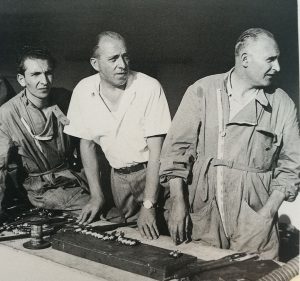
Gioachino Colombo (centre)
Renowned engineer Gioachino Colombo was engaged to work on that first V12, starting in August 1945. Colombo had learned his craft at Alfa Romeo before the Second World War, under the great engineer Vittorio Jano. Working from his home in Milan, Colombo drew up an engine for Ferrari that was based an alloy block with cylinders formed using cast iron wet liners. The two banks of six cylinders were set at a 60 degree angle, the classic arrangement for a V12 engine.
The capacity of the new engine was to be just 1497cc. Colombo specified a 55mm bore diameter, with plenty of metal between the cylinders to allow for bigger bores later – a foresighted decision which was to prove vital as the Ferrari brand became established and its racing activities expanded. The very short 52.5mm stroke meant the overall height of the engine could be kept low, and at the same time it reduced internal stresses so that the engine could touch 7000rpm.
Each bank of cylinders had a single overhead camshaft, both of them driven by the same double-row chain from the nose of the crankshaft. The valves were operated by rockers and closed by unusual hairpin-type springs.
More Power: Bigger Bore & More Camshafts
The V12 first ran on a test bed in September 1946, delivering 70bhp – a good output for the era, if not a spectacular one. But by the time the new motor had been fettled by Ferrari’s master engine tuner Luigi Bazzi it could produce a reliable 118bhp. The following spring, the V12 powered the first car to be sold under Ferrari’s own name, the 1947 125 S. The number was (approximately) the capacity of a single cylinder, a naming scheme Ferrari would go on to use for many of its cars – including the 365 GTB/4 Daytona.
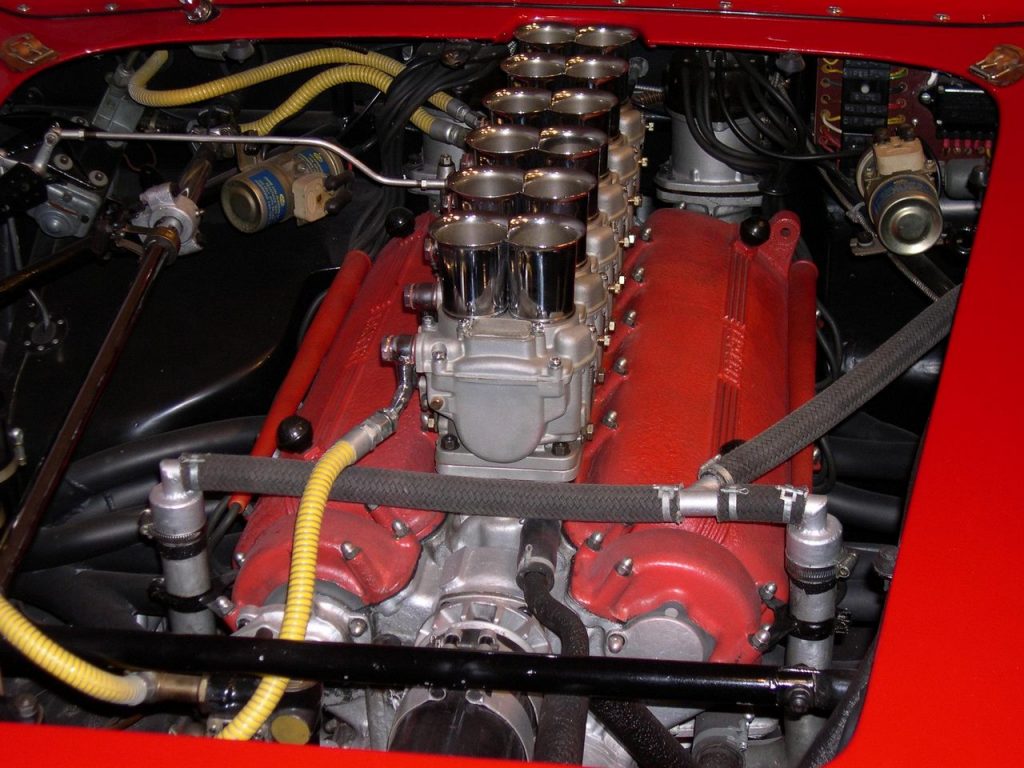
Colombo Testa Rossa engine in a 1958 250TR
In the search for more power the Colombo V12 was gradually expanded in bore and stroke, with the capacity growing to 2953cc in the famous 250 engines of the 1950s. That branch of the engine family reached its height in the fabulous 250 GTO race car.
The next development was to relocate the spark plugs from the engine vee to the outsides of the cylinder heads, between the exhaust manifold primaries. That made space for a more efficient intake system using six downdraft Weber carburettors.
The development of the Colombo engine then took two separate, parallel paths, both of which would be vital to the creation of the engine that would power the Daytona.
- The first path was the development of a long-stroke 4.0-litre version of the V12 for the Ferrari 330 America in 1963. At the same time the block was redesigned with wider cylinder spacing which would be able to accommodate bigger bores, so the engine capacity could grow still further.
- Meanwhile, the short-stroke 3.3-litre 275 GTB engine was developed in a different direction. The top end of the engine was redesigned with double overhead camshafts on each cylinder bank, still chain driven. The spark plugs moved again, this time sitting between the cams so that each one was centred in its combustion chamber. The four-cam engine developed 330bhp, about 10% more than the two-cam 3.3-litre, and went into the 275 GTB/4.
Finally…The Ferrari 365 GTB4 (1968)
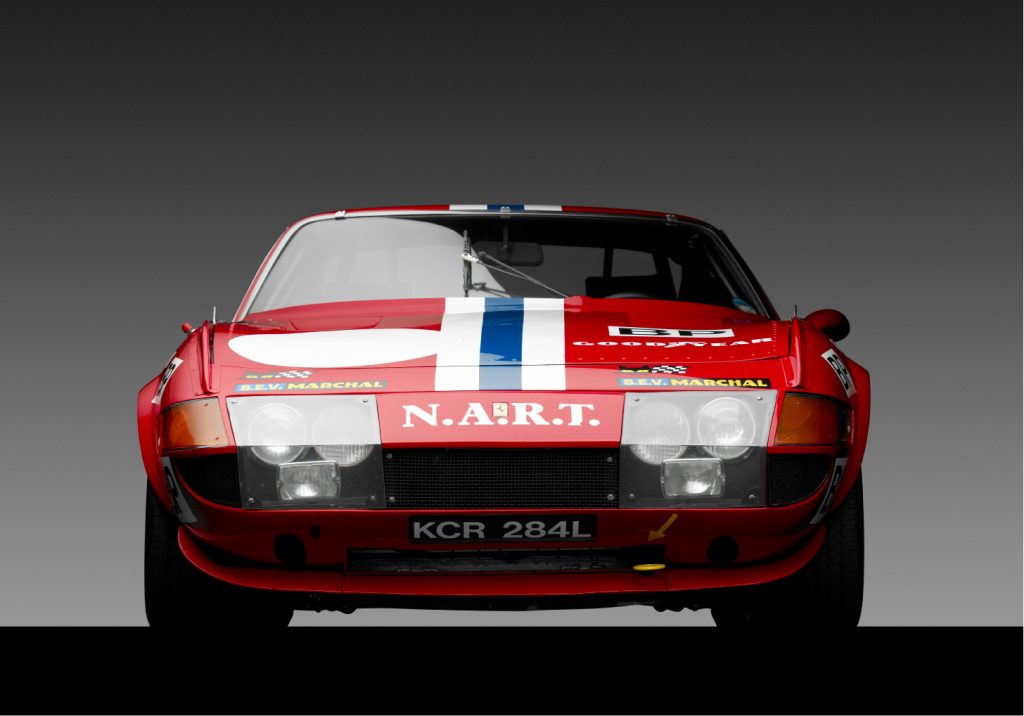
North American Race Team (NART) Ferrari 365 GTB4 for Luigi Chinetti
The two strands of development came back together in the Daytona of 1968. The long-stroke 330 America engine was bored out still further to 81mm to produce a capacity of 4390cc. With four-cam valve gear developed from the 275 GTB/4, the Tipo 251 Daytona engine produced 352bhp – the most powerful Colombo V12 that Ferrari ever offered in a production car.
Still more was to come. The last of the rare 365 GTB/4 Competizione cars, built by Ferrari for trusted privateer racing teams, had a host of detail engine upgrades. There were special pistons that raised the engine’s compression ratio, high-strength billet steel connecting rods, high-lift camshafts, and carburettors with larger jets that breathed from a new cold-air plenum. The result was 450bhp, enough to take the fight to the best of the racing Chevrolet Corvettes. Some of the cars were developed still further over the years and ended up delivering up to 480bhp, which was as much as a Formula 1 car of the time.
Later Ferrari GT Cars
After the Daytona, the Colombo V12 powered a series of handsome GT cars – the 365 GT4 2+2, 400, 400i and 412 – before it was finally phased out in 1988. In the four decades since the original version had appeared, the Colombo V12 had grown from 1.5-litres to almost 5.0-litres, and the power output that had started at 70bhp in the initial tests in 1946 had rocketed to nearly 500bhp in the final racing Daytonas of the 1970s. It appeared in everything from lightweight sports racing cars to luxurious, leather-clad GTs, and outlived two more Ferrari V12 engines designed by Aurelio Lampredi and Frank Rocchi.
The Colombo V12 was the engine that cemented Ferrari’s unique position in automotive history. It was at the very heart of the Daytona, one of the most iconic models Maranello has ever made.
Later Ferrari GT Cars
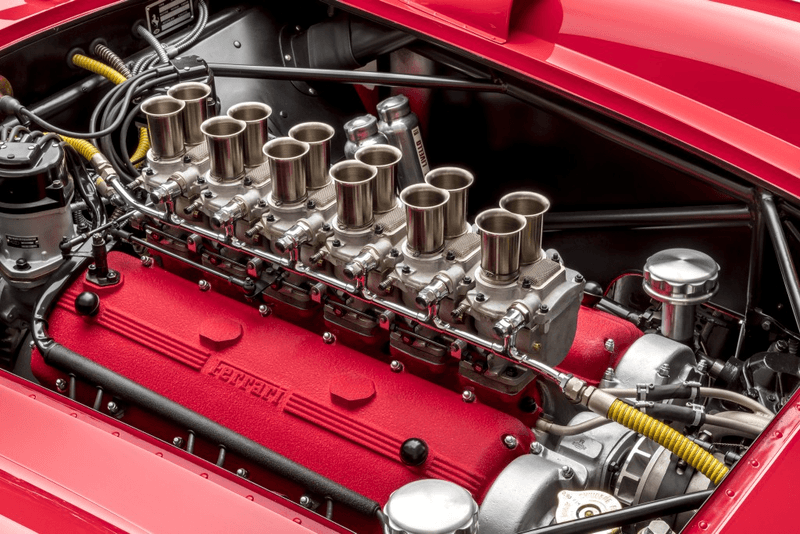 After the Daytona, the Colombo V12 powered a series of handsome GT cars – the 365 GT4 2+2, 400, 400i and 412 – before it was finally phased out in 1988. In the four decades since the original version had appeared, the Colombo V12 had grown from 1.5-litres to almost 5.0-litres, and the power output that had started at 70bhp in the initial tests in 1946 had rocketed to nearly 500bhp in the final racing Daytonas of the 1970s. It appeared in everything from lightweight sports racing cars to luxurious, leather-clad GTs, and outlived two more Ferrari V12 engines designed by Aurelio Lampredi and Frank Rocchi.
The Colombo V12 was the engine that cemented Ferrari’s unique position in automotive history. It was at the very heart of the Daytona, one of the most iconic models Maranello has ever made.